Facebook
 X
X
 Pinterest
 Copy Link
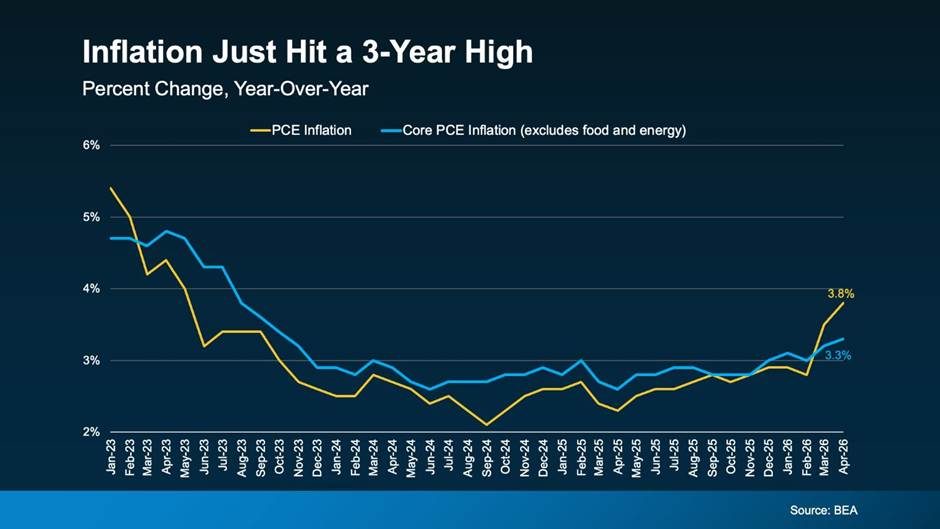
Data shows inflation is rising. Here’s what’s actually going on, why it matters for the housing market, and what it means if you’re considering buying or selling.
Inflation Went Up – Here’s What That Actually Means
The government tracks inflation in a variety of ways. One method is called the Personal Consumption Expenditures Price Index (PCE). It measures how much more (or less) people are paying for goods and services compared to a year ago. And just based on your own expenses, you can probably guess which way that’s trending.
See the yellow line on the graph for how that’s spiked since February. A big driver is the ongoing conflict in the Middle East, which has pushed gas and energy prices significantly higher. The blue line shows core PCE. That’s the same measure, but with gas and energy prices stripped out. The Federal Reserve (the Fed) watches this number most closely because energy prices alone can be misleading.
Here’s the somewhat encouraging part: Core PCE is rising, but not nearly as fast as the overall number. That suggests a good chunk of the inflation we’re seeing right now is tied to what’s happening overseas. So, when that situation settles down, inflation may settle a bit, too.
Why This Matters for Mortgage Rates
Here’s the housing connection. When inflation is high, the Fed tends to keep the Federal Funds Rate elevated or even raise it to try to taper spending and cool inflation back down. And while it’s not a one-for-one relationship, that Federal Funds Rate can have an impact on your mortgage rate when you buy.
Based on the information we have, there’s roughly a 50/50 chance the Fed actually raises the Federal Funds Rate before the end of 2026, according to CME FedWatch. While it’s too soon to say where this goes for certain and if we’re headed for a rate hike, it does mean mortgage rates are probably not coming down as soon as most people were hoping.
But This Is Not 2008 – Not Even Close
Remember, a tough economy does not equal a housing crash. The conditions today are very different from what led to the 2008 collapse. Here’s why:
- Inventory is still relatively low. There’s no flood of homes hitting the market.
- Most homeowners today have strong equity in their homes.
- Lending standards are far stricter than they were before 2008.
- Today’s challenge is affordability, not a wave of distressed underwater sellers.
Bottom Line
Inflation is still above where the Fed wants it, and that means mortgage rates are likely to stay elevated for a while. But for people who need to move, strategy matters far more than trying to perfectly time the market. Wondering what this means for your specific situation? Reach out today. Let’s cut through the noise together and make a plan that works for you.